This study provides a comprehensive overview of Deaf culture, linguistic distinctions, communication etiquette, and the legal framework for accessibility. It is designed to synthesize information regarding the lived experiences of deaf and hard of hearing individuals, the nuances of sign language, and the technologies that support interaction.
Part I: Knowledge Review Quiz
Instructions: Answer the following questions in two to three sentences based on the provided materials.
- What is the linguistic and cultural distinction between “deaf” (lowercase d) and “Deaf” (uppercase D)?
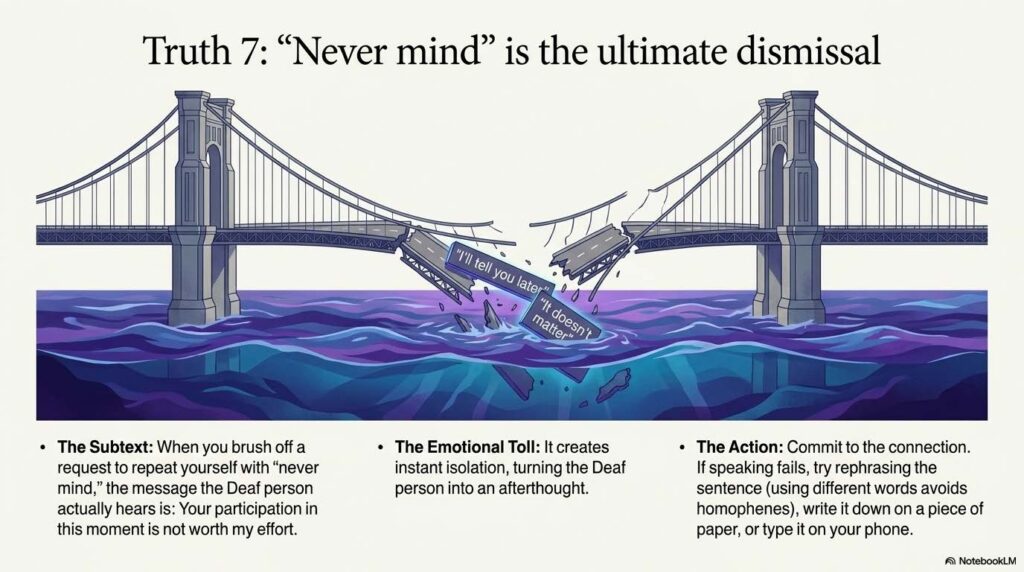
- Why is the phrase “It doesn’t matter” or “Never mind” considered one of the most offensive things to say to a deaf person?
- Explain why shouting is ineffective and often counterproductive when communicating with individuals who have hearing loss.
- What are the primary limitations of lipreading as a communication method?
- Describe the correct etiquette for engaging in a conversation when a sign language interpreter is present.
- How does American Sign Language (ASL) differ from English in its structure and nature?
- What are the legal requirements for “effective communication” under the Americans with Disabilities Act (ADA)?
- Why is the assumption that deaf people cannot drive considered a misconception?
- What is “audism,” and how does it manifest in common “compliments” given to deaf individuals?
- What are “auxiliary aids and services,” and who is responsible for the cost of providing them in public accommodations?
Part II: Answer Key
- What is the linguistic and cultural distinction between “deaf” (lowercase d) and “Deaf” (uppercase D)? The term “deaf” with a lowercase “d” is a general medical description for anyone with significantly reduced hearing. In contrast, “Deaf” with a capital “D” refers to individuals who identify with the Deaf community and participate in Deaf culture, which is deeply rooted in the use of American Sign Language (ASL).
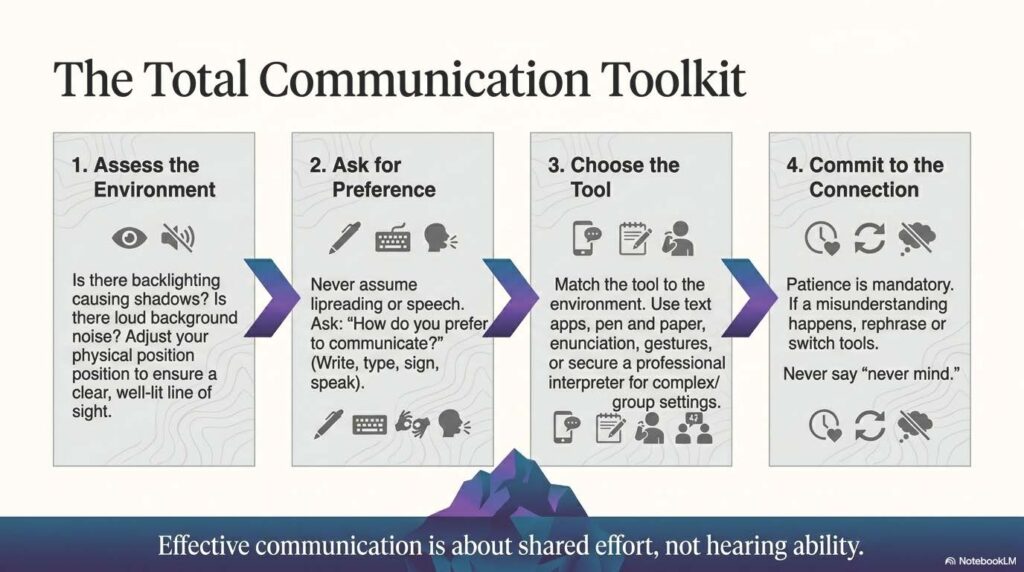
- Why is the phrase “It doesn’t matter” or “Never mind” considered one of the most offensive things to say to a deaf person? These phrases are dismissive and signal that the deaf person’s participation or understanding is not worth the effort required to repeat or rephrase information. This effectively excludes the individual from the conversation, making them feel invisible or as though they “don’t matter.”
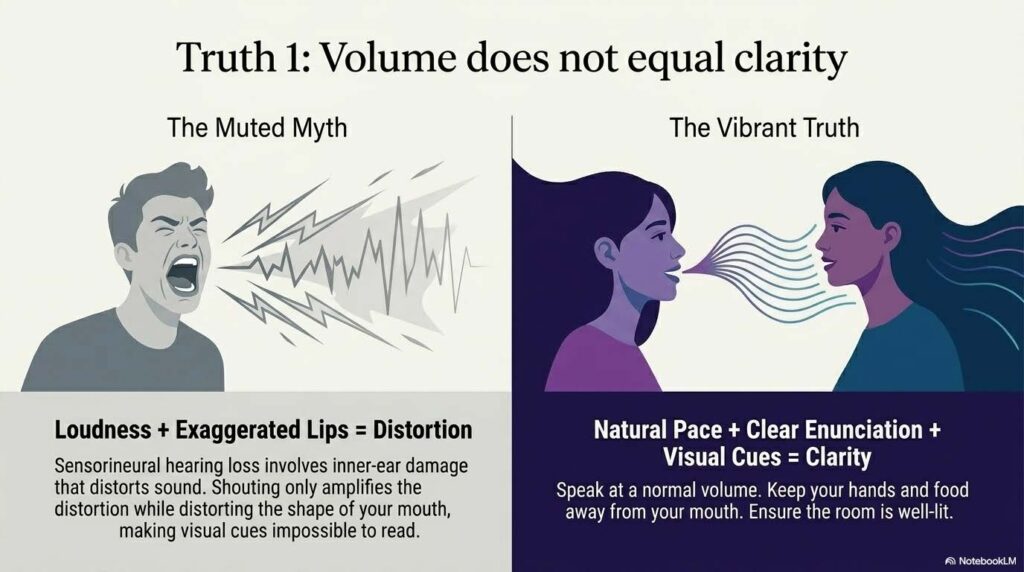
- Explain why shouting is ineffective and often counterproductive when communicating with individuals who have hearing loss. Shouting does not improve clarity because hearing loss often involves sound distortion that volume cannot fix, and yelling exaggerates mouth movements, making lipreading much harder. Additionally, for those using hearing aids, shouting can be physically uncomfortable or even painful as the device amplifies the already loud sound.
- What are the primary limitations of lipreading as a communication method? Lipreading is an imprecise skill where even the most proficient users typically understand only about 25% of what is said, as many English sounds (homophenes) look identical on the lips. It requires significant guesswork and is usually used only as a supplement to residual hearing or other assistive technologies rather than as a primary source of information.
- Describe the correct etiquette for engaging in a conversation when a sign language interpreter is present. Speakers should maintain eye contact and speak directly to the deaf person rather than the interpreter, avoiding phrases like “tell him” or “ask her.” The interpreter’s role is to facilitate the conversation between the two parties, and they should not be asked for their personal opinions or to withhold information from the deaf participant.
- How does American Sign Language (ASL) differ from English in its structure and nature? ASL is a distinct, complete, and natural language with its own unique grammatical rules, syntax, and cultural identity, rather than a gestural code for English. It utilizes visual cues, body language, and facial expressions to convey meaning, making it linguistically separate from spoken languages.
- What are the legal requirements for “effective communication” under the Americans with Disabilities Act (ADA)? The ADA mandates that public (Title II) and private (Title III) health care providers and public accommodations must provide auxiliary aids and services to ensure deaf and hard of hearing individuals have equal access to services. Communication must be as effective as it is for individuals without hearing loss, often requiring the provision of qualified interpreters or real-time transcription.
- Why is the assumption that deaf people cannot drive considered a misconception? Driving is primarily a visual task, and deaf drivers are statistically proven to be safer than hearing drivers due to higher visual alertness and quicker motor reflexes. They are often more attuned to visual cues, such as the flashing lights of emergency vehicles, which they can often spot more quickly than hearing drivers who rely on sirens.
- What is “audism,” and how does it manifest in common “compliments” given to deaf individuals? Audism is the belief that hearing and speaking are superior forms of communication, often manifesting as backhanded compliments like “You speak so well for a deaf person.” Such remarks imply that a deaf person’s “normal” state is to be less capable and prioritize spoken English over the individual’s natural communication methods.
- What are “auxiliary aids and services,” and who is responsible for the cost of providing them in public accommodations? Auxiliary aids and services include qualified interpreters, note-takers, transcription services (CART), and assistive listening devices. Under the ADA, businesses and agencies are prohibited from imposing a surcharge on individuals with disabilities to cover these costs; the entity providing the service must absorb the expense.
Part III: Essay Questions
Instructions: Use the provided sources to develop comprehensive responses to the following prompts.
- The Spectrum of Identity: Compare and contrast the medical model of deafness (viewing it as a deficit or tragedy) with the cultural model (viewing it as a unique identity and community). How do these different perspectives influence the way hearing people interact with the Deaf?
- Linguistic Allyship: Discuss why treating American Sign Language as a “simplified version of English” is linguistically inaccurate and culturally insensitive. What steps can a hearing person take to show genuine respect for the language?
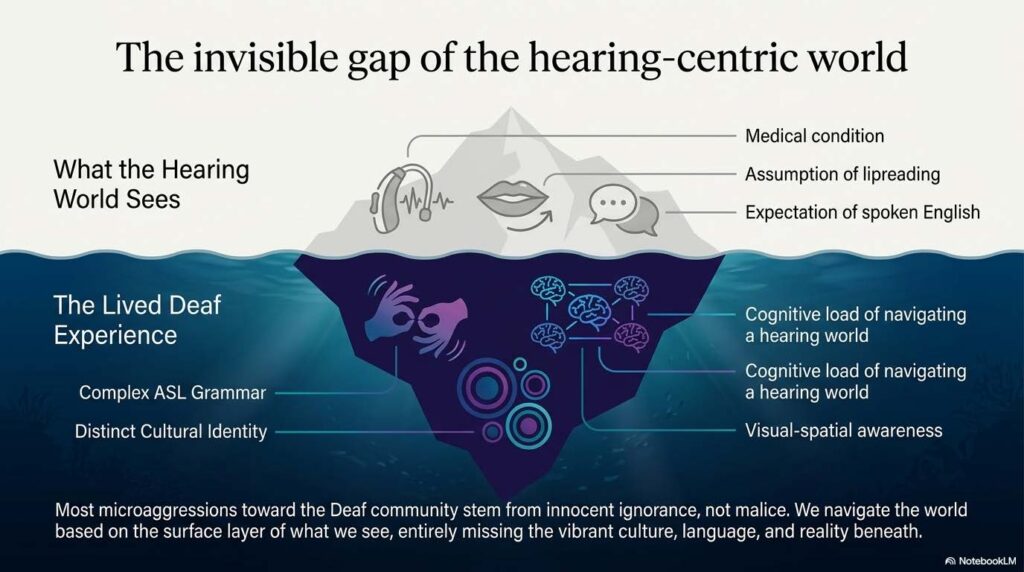
- The Burden of Accessibility: Analyze the daily effort required for a deaf person to navigate a “hearing-centric” world, citing specific examples of microaggressions and communication barriers discussed in the texts.
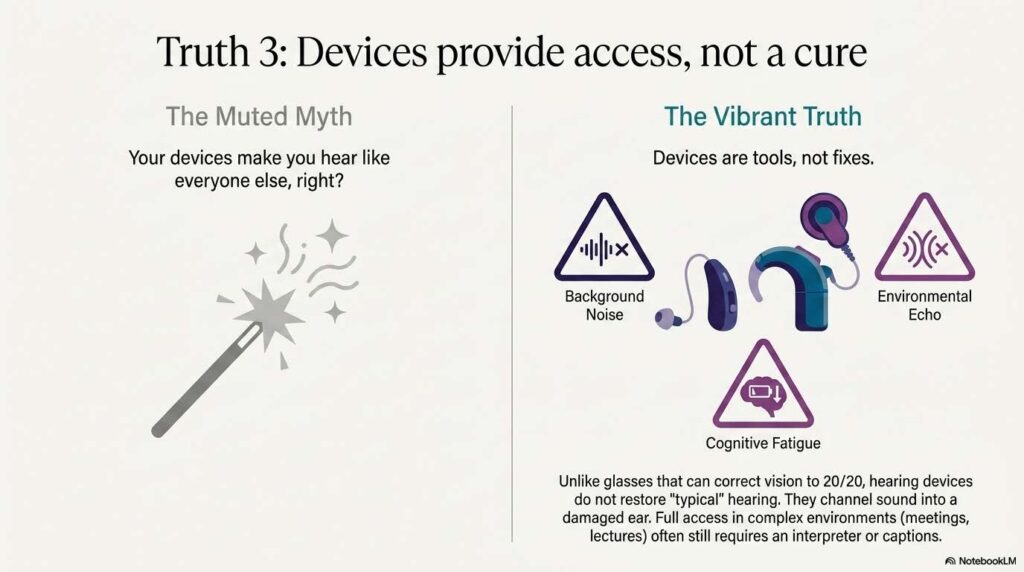
- Technological Choices: Explore the complexities surrounding cochlear implants and hearing aids. Why might a member of the Deaf community view these devices as “solutions” rather than “cures,” and why is the decision to use them considered deeply personal?
- Legal and Ethical Obligations: Evaluate the responsibilities of a service provider (such as a doctor or hotel manager) in ensuring safety and effective communication for deaf clients. What are the potential consequences of failing to meet these obligations?
➡️ Read More : Deaf Communication Etiquette: Beyond Audism & Volume Control
➡️ Read More : Beyond the Gesture: 5 Scientific Truths About the Hidden Architecture of ASL
➡️ Use the free tool here: ASL Gloss Translator and image converter.
Part IV: Glossary of Key Terms
| Term | Definition |
| ADA (Americans with Disabilities Act) | A federal civil rights law that prohibits discrimination against individuals with disabilities in all areas of public life, including jobs, schools, and transportation. |
| ALDs (Assistive Listening Devices) | Technology designed to improve sound transmission for people with hearing loss, such as FM systems, pocket talkers, or neck loops. |
| ASL (American Sign Language) | A complete, natural language used by the Deaf community in the United States, featuring unique grammar and syntax distinct from English. |
| Audism | Discrimination or prejudice against individuals who are deaf or hard of hearing, based on the belief that hearing is superior. |
| Auxiliary Aids and Services | Tools and services, such as interpreters or transcription, used to ensure effective communication with individuals who have hearing, vision, or speech disabilities. |
| CART (Computer-Aided Transcription) | A service that provides real-time, word-for-word speech-to-text translation for individuals who are deaf or hard of hearing. |
| Cochlear Implant | A complex electronic device that can help provide a sense of sound to a person who is profoundly deaf or severely hard-of-hearing; it is not a “cure” for deafness. |
| Hard of Hearing | A term generally used to describe people with a mild to moderate hearing reduction who usually have some access to spoken language. |
| HAT (Hearing Assistive Technology) | A broad category of technology, including ALDs and alerting devices (like vibrating alarms), that assists deaf and hard of hearing people in daily life. |
| Homophenes | Different words that look exactly the same on the lips when spoken, making lipreading difficult (e.g., “pat,” “bat,” and “mat”). |
| Late-deafened | Individuals who lose their hearing after childhood, specifically after they have acquired spoken language. |
| Lipreading (Speechreading) | The practice of understanding speech by watching the movements of the lips, face, and tongue; it is often inaccurate and exhausting. |
| Microaggression | Subtle, everyday slights or insults—often unintentional—directed at marginalized groups, such as suggesting a deaf person “doesn’t look deaf.” |
| TTY (Telecommunication Device for the Deaf) | A device that allows people to communicate via telephone by typing messages back and forth. |
| VRS (Video Relay Service) | A telecommunication service that allows deaf individuals to use sign language to communicate with hearing people via a video interpreter. |
➡️ Read More : Deaf Communication Etiquette: Beyond Audism & Volume Control
➡️ Read More : Beyond the Gesture: 5 Scientific Truths About the Hidden Architecture of ASL
➡️ Use the free tool here: ASL Gloss Translator.
ASL Picture Dictionary Online – Sign Words with Pictures: https://asltyping.com/asl-picture-dictionary/