The Science of Signs: A Guide to ASL Linguistics & Structure
This document provides a comprehensive synthesis of the linguistic foundations, grammatical structures, and descriptive models of American Sign Language (ASL). It draws exclusively from specialized texts on ASL linguistics and associated technical documentation.
1. The Nature of ASL as a Language
American Sign Language is a natural, rule-governed communication system used by the North American Deaf community. It is a distinct, autonomous linguistic system independent of English, characterized by its own unique phonology, morphology, and syntax.
Key Characteristics of Language Found in ASL
- Symbolic Organization: ASL uses symbols (signs) organized systematically. Sign formation is not random; for example, the Symmetry Condition dictates that in two-handed signs where both hands move, they must have the same handshape and movement (e.g., DRAMA). The Dominance Condition states that if hands have different shapes, only the dominant hand moves while the passive hand remains stationary (e.g., WORD).
- Productivity: ASL is capable of producing an infinite number of sentences and encoding any topic, from survival to philosophy.
- Displacement: It can refer to the past, future, and non-immediate situations (e.g., using the sign YESTERDAY to reference prior events).
- Arbitrariness and Iconicity: While some signs are iconic (resembling what they represent, like SIT), they are still linguistic units schematized by the language. Many signs are arbitrary, where the form does not reflect the concept (e.g., WRONG).
ASL Picture Dictionary Online – Sign Words with Pictures: https://asltyping.com/asl-picture-dictionary/
Historical Origins
The formalization of ASL in educational settings began in 1817 when Thomas Hopkins Gallaudet and Laurent Clerc established the American School for the Deaf in Hartford, Connecticut. ASL evolved from a blend of French Sign Language (brought by Clerc), indigenous signs from places like Martha’s Vineyard, and home signs used by students.
2. Phonology: The Building Blocks of Signs
Phonology in ASL is the study of the smallest contrastive units that make up signs. These units, known as parameters, include handshape, movement, location, palm orientation, and nonmanual signals.
The Five Parameters
| Parameter | Description |
| Handshape | The configuration of the fingers (e.g., the ‘1’ handshape in THINK). |
| Location | Where the sign is made (e.g., the forehead for KNOW). |
| Movement | The action of the sign (e.g., upward, downward, or circular). |
| Palm Orientation | The direction the palm faces (e.g., palm up in DIE). |
| Nonmanual Signals | Facial expressions and head movements (e.g., raised eyebrows for questions). |
Linguistic Models of Sign Structure
Two primary models describe how these parameters are organized:
The Stokoe System
Developed by William C. Stokoe in 1960, this was the first system to suggest signs have internal structure.
- Components: He identified three parameters: Tabula (location), Designator (handshape), and Signation (movement).
- Cheremes: Meaningless elements that combine simultaneously to form a sign.
- Limitations: The Stokoe system viewed signs as simultaneous wholes and struggled to describe the level of detail and sequentiality found in many signs.
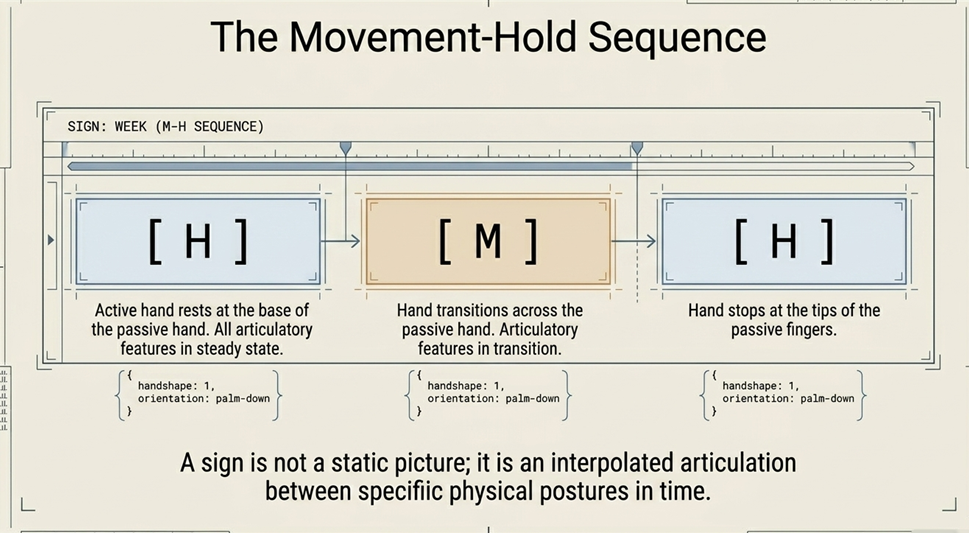
The Movement-Hold Model
Developed by Scott K. Liddell and Robert E. Johnson, this model argues that signs consist of sequential segments:
- Holds (H): Periods where all aspects of the sign are in a steady state.
- Movements (M): Periods where some aspect of the articulation is in transition.
- Sign Structures: Signs can be categorized by their segmental patterns, such as M H (THINK), H M H (GOOD), or M H M H (CONGRESS).
Phonological Processes
As signs are produced in sequence, several processes can alter their form:
- Movement Epenthesis: Adding a movement segment between two signs (e.g., FATHER STUDY).
- Hold Deletion: Eliminating holds between signs to allow for more fluid movement.
- Metathesis: Parts of the segments of a sign changing places (e.g., the sign DEAF can start at the chin or the ear).
- Assimilation: A segment taking on characteristics of a neighboring segment (e.g., PRO.1 taking the handshape of a following sign).
ASL Picture Dictionary Online – Sign Words with Pictures: https://asltyping.com/asl-picture-dictionary/
3. Morphology: Word and Sign Formation
Morphology explores the smallest meaningful units (morphemes) and how they build new signs.
Deriving Nouns from Verbs
In ASL, many nouns are derived from verbs through a process called reduplication (repeating the movement).
- Verbs: Often have a single, long movement (e.g., SIT).
- Nouns: Often have a repeated, restrained movement (e.g., CHAIR).
- Examples: FLY/AIRPLANE, SELL/STORE, OPEN-BOOK/BOOK.
Compounding
New signs are created by combining two existing signs. This process follows specific morphological rules:
- First Contact Rule: Only the first contact hold of a sign is kept in the compound.
- Single Sequence Rule: Internal movements or repetitions are eliminated (e.g., the sign for SISTER drops the repetition found in the sign GIRL).
- Weak Hand Anticipation: The passive hand often prepares for the second sign of a compound while the active hand is still making the first sign (e.g., BELIEVE).
Numeral Incorporation
In some signs, a number handshape is blended into the base sign to change the meaning of quantity.
- Examples: THREE-WEEKS, NINE-MONTHS, FIVE-DOLLARS.
The Function of Space
Space in ASL is multi-functional:
- Articulatory: The physical area where signs are made.
- Morphological/Locative: Showing spatial relationships between objects.
- Referential: Establishing a location for a person or object that can be referred to later.
- Frame of Reference: Showing different perspectives in a narrative.
4. Syntax and Language Use
Sentence Types and Nonmanual Signals
Syntax involves the rules for constructing sentences. ASL uses unique structures often marked by nonmanual signals:
- Topic-Comment: The topic is established first (often with raised eyebrows), followed by a comment about it.
- Questions: Yes-no questions are marked by raised eyebrows and head tilt; rhetorical questions are used to provide information rather than seek it.
- Directional Verbs: Verbs like GIVE or HELP incorporate the subject and object through the direction of their movement.
Artistic and Social Variations
- Language as Art: ASL includes artistic forms such as storytelling, percussion signing, drama, comedy, and poetry.
- Variation: Signers use different variants based on region, age, gender, and ethnicity. One significant variant noted in the Deaf community is Black ASL, which reflects specific sociolinguistic developments.
5. Modern Tools and Technical Contexts
ASL Typing and Translation Tools
Modern technology has introduced tools for “ASL Typing” and converters. These tools:
- Convert English text into a gloss sentence structure.
- Generate ASL-style font designs and images for social media and educational visuals.
- Assist beginners in exploring visual sign language ideas, such as name designs and short phrases.
The “ASL” Abbreviation in Software
In specific technical and software development contexts, “ASL” may refer to the Adobe Source Libraries. These are C++ software libraries covered under the MIT License, which allows for specific terms of use in open-source programming. These libraries are distinct from the linguistic study of American Sign Language.
Important Quotes
“Linguistic inquiry is a dynamic and flexible undertaking, not a frozen or static one.” — Linguistics of American Sign Language, 3rd Edition
“In 1960, [Sign Language Structure] argued that paying attention to sign language could only interfere with the students’ proper education.” — William C. Stokoe, 1988
“Hands can speak what words cannot.” — Home – Help in ASL Typing
