Bridging the Communication Gap
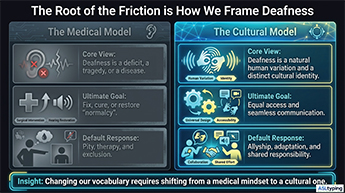
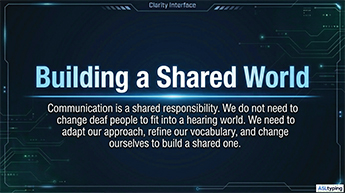
In professional and social environments, we often conflate hearing with listening. Genuine listening requires intent and a shift in perspective. As mental health expert Neil Glickman emphasizes, hearing individuals do not need to “fix” or change Deaf people; rather, they must change their own thinking to foster relationships built on equality, mutuality, and collaboration. Inclusive communication is defined by Clarity over Volume. Shouting does not bridge the gap; it only creates distortion and frustration.
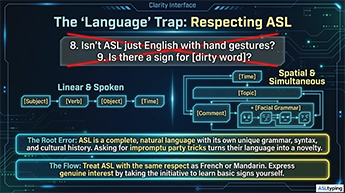
Understanding the distinction in terminology is a vital first step. The lowercase “deaf” typically refers to the medical condition of hearing loss. In contrast, the uppercase “Deaf” refers to individuals who identify as members of a linguistic and cultural minority. This community has deep roots in American Sign Language (ASL), which is a distinct, natural language with its own unique grammar and syntax, rather than a gestural code for English. Our goal is to move away from a medical model of “deficits” and toward a cultural model of inclusion that treats Deaf colleagues and peers as competent equals.
Category 1: The “Dismissives” (Communication Barriers)
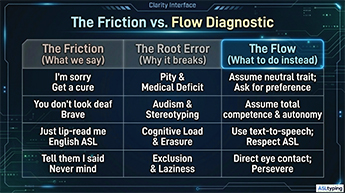
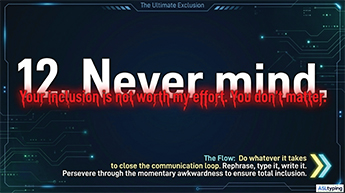
Phrase 1: “Never mind,” “It doesn’t matter,” or “I’ll tell you later.”
This is universally regarded as the most frustrating phrase a Deaf person can hear. It effectively signals that the individual—and their right to be part of the conversation—is not worth the effort. It creates a profound sense of invisibility and exclusion.
Better Alternatives:
- Rephrase: Use different words or synonyms to clarify the point.
- Write it down: Utilize a pen and paper or a notes app on your smartphone.
- Use technology: Use a speech-to-text app to provide real-time transcription of your words.
- Be patient: Allow the time necessary for everyone to catch up. The information is important because the person is important.
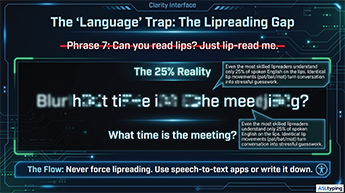
Phrase 2: “Can you read lips? Just lip-read me.”
Lip-reading is often romanticized as a “superpower,” but in reality, it is an exhausting and unreliable supplement to communication, not a primary solution.
According to the National Association for the Deaf, even the most skilled lip-readers understand an average of only 25% of what is said.
Why it fails as a primary method:
- Homophenes: Many words (like “pat,” “bat,” and “mat”) look identical on the lips.
- Barriers: Facial hair, covering the mouth, or eating makes lip-reading impossible.
- Individual Variation: Different accents, unique speaking styles, and poor lighting further degrade the understanding rate.
- Environmental Factors: Turning your head or standing in shadows breaks the visual link.
Category 2: Backhanded Compliments & Stereotypes
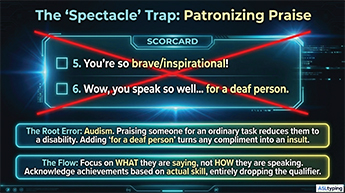
Phrase 3: “You speak so well for a deaf person!”
This is a backhanded compliment rooted in “audism”—the belief that hearing and speaking are superior. It prioritizes spoken language as the “correct” standard and expresses surprise that a Deaf person deviates from a prejudiced expectation of incompetence. It also ignores the years of exhaustive effort often required to develop spoken English.
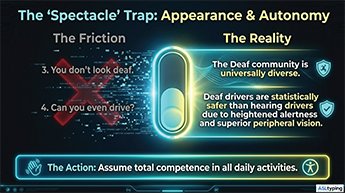
Phrase 4: “Wow, I would never have guessed you’re deaf / You don’t look deaf.”
Deafness is an internal hearing status, not a physical trait with a specific “look.” This comment implies that being Deaf is something that should be identifiable or, conversely, something that is better hidden.
Phrase 5: “You’re so brave/inspirational!”
In the community, this is often called “inspiration porn.” It patronizes Deaf individuals for performing mundane, daily activities. For example, Kenji, a Deaf software engineer, notes the irritation of being called “inspirational” for simply going to the grocery store. This language stems from a hearing-centric framework that views deafness as a tragedy to be “overcome,” rather than a neutral characteristic of a normal, lived experience.
➡️ Read More : Deaf Communication Etiquette: Beyond Audism & Volume Control
➡️ Read More : Beyond the Gesture: 5 Scientific Truths About the Hidden Architecture of ASL
➡️ Use the free tool here: ASL Gloss Translator.
Category 3: Invasions of Privacy & Medical Curiosity
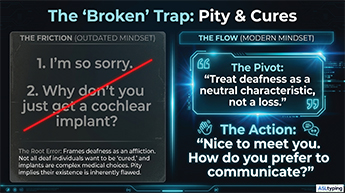
Phrase 6: “Why don’t you just get a cochlear implant or hearing aids?”
Technology is not an “easy fix” or a “cure.” Choosing a cochlear implant (CI) is a deeply personal decision involving significant financial costs, medical risks, and a painful recovery process. Furthermore, technology does not restore “normal” hearing; it provides a different auditory experience. Many in the community do not consider themselves “broken” and have no desire to be “fixed” or cured.
Phrase 7: “Is there a sign for [English word/Dirty word]?”
This question treats ASL as a novelty or a simple code for English rather than a complex language. It also places an unpaid burden on the Deaf person to act as a “walking dictionary,” which can make them feel like a spectacle rather than a professional peer.
Phrase 8: “It must be so quiet! / Do you hear anything at all?”
Hearing loss exists on a vast spectrum. The concept of “quiet” is often irrelevant to those who have never experienced sound or who perceive sound through vibrations. These questions are intrusive medical inquiries into a subjective sensory experience and should be avoided.
Category 4: Assumptions of Incompetence
Phrase 9: “Can you even drive?”
This is a common misconception. Driving is primarily a visual task, and Deaf individuals navigate the road with high proficiency.
Fast Fact:
Deaf drivers are statistically safer than hearing drivers. This is due to higher levels of visual alertness, quicker motor reflexes, and better peripheral vision. They are also less likely to be distracted by auditory sources and are often quicker to spot the flashing lights of emergency vehicles.
Phrase 10: “I’m sorry.”
Apologizing for someone’s hearing status frames their identity as a misfortune. This is as inappropriate as apologizing for someone having brown hair or being left-handed.
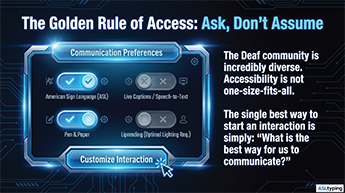
Neutral Response:Move the conversation forward by focusing on access. Ask: “How do you prefer to communicate?” or “What methods work best for you?”
Category 5: Professional & Etiquette Faux Pas
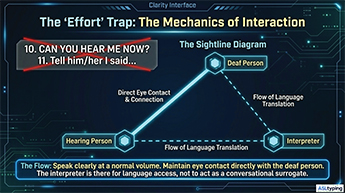
Phrase 11: “Tell him/her…” (Talking to the interpreter instead of the person).
Always direct your speech and eye contact to the Deaf person, not the interpreter or companion. Bypassing the Deaf person is a violation of their autonomy.Professional Tip: In a 1:1 setting, the interpreter should sit next to and slightly behind the speaker so the Deaf person can see both the speaker’s expressions and the interpreter’s signs within their line of sight.
Phrase 12: Using outdated terms.
Language evolves, and medical labels from the past are now considered offensive or reductive.
|
Avoid These Terms
|
Use These Terms Instead
|
|---|---|
|
Deaf and Dumb / Deaf-Mute / Mute
|
Deaf
|
|
Hearing Handicapped
|
Deaf or Hard of Hearing
|
|
Hearing Impaired
|
Person with hearing loss (Note: “Impaired” has negative connotations)
|
|
Non-Verbal
|
ASL User
|
Proactive Communication Strategies
To ensure an accessible professional environment, implement these strategies:
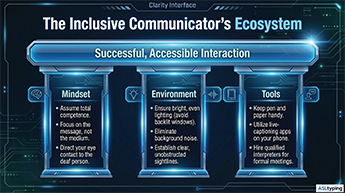
- Visual Clarity: Maintain a clear line of sight. Ensure bright lighting and avoid standing in front of windows (which creates a “silhouette” effect on your face).
- Getting Attention: Wave your hand in their line of sight, or tap them lightly on the shoulder. For groups, flicker the lights.
- Mouth Visibility: Do not cover your mouth, eat, or chew gum while speaking.
- Establish the Topic: Clearly state the subject before beginning or when changing topics (e.g., “Regarding the quarterly report…”).
- Allow for “Eye Breaks”: Listening with one’s eyes requires significantly more concentration and is mentally exhausting. Provide frequent breaks.
- Total Communication: Be flexible. Use a combination of speech, speechreading, sign language, gestures, and writing/typing to ensure the message is clear.
Legal and Professional Support
Under the Americans with Disabilities Act (ADA) Titles II and III and the Rehabilitation Act, organizations are legally obligated to provide “effective communication.” The bar for “undue burden” (refusing a service due to cost) is very high and rarely met in court; the financial impact is measured against the entire entity, not the individual transaction.
Required Auxiliary Aids and Services include:
- Qualified sign language interpreters (including Certified Deaf Interpreters for complex needs).
- CART (Computer-Aided Real-Time Transcription).
- Hearing Assistive Technology (HAT) such as FM systems, pocket talkers, and induction loops.
- Telecommunication devices (TDD/TTY, captioned phones, and Video Relay Services).
- Written materials and notetakers.
9. Conclusion: Moving Forward with Respect
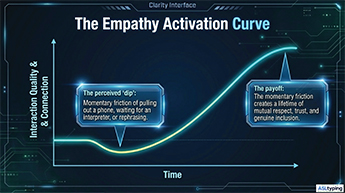
Effective communication is built on the philosophy of “Talk Smarter, Not Louder.” Shouting only serves to distort your message and create an aggressive atmosphere. Genuine connection is built on patience, creativity, and the fundamental recognition of Deaf colleagues and peers as equals. By adopting these respectful practices and proactively ensuring accessibility, we create a professional environment where everyone is a valued, participating member of the conversation.
➡️ Read More : Deaf Communication Etiquette: Beyond Audism & Volume Control
➡️ Read More : Beyond the Gesture: 5 Scientific Truths About the Hidden Architecture of ASL
➡️ Use the free tool here: ASL Gloss Translator.
One Response