The Silent Bridge Between Two Worlds
Translating English into American Sign Language (ASL) is an exercise in shifting paradigms. While English follows the “march of the pen”—a linear, sequential progression of words—ASL thrives in the “dance of the hands,” utilizing a three-dimensional landscape of spatial syntax and visual architecture. For many learners and creators, the challenge lies in breaking away from the rigid structure of spoken sentences to embrace the fluid, conceptual nature of signs. This is where the concept of “glossing” becomes an essential bridge, providing a written scaffolding that helps us visualize a language that was never meant to be confined to paper.
Use Free ASL Gloss Translator online
Deciphering the “Gloss”: Why ASL Structure is the Secret Sauce
In the world of ASL instructional design, a “gloss” is more than just a translation; it is a specialized representation of sign language grammar in written form. Because ASL possesses its own unique linguistic rules, glossing allows us to capture the non-linear conceptualization required for true fluency. It helps learners account for Topic-Comment structure and provides a placeholder for Non-Manual Markers (NMMs)—the facial expressions and body movements that provide the necessary “tone of voice” in a visual medium.
“Hands can speak what words cannot.”
Glossing is a critical tool because it forces the brain to move past literal, word-for-word translation. By mapping out the visual architecture of a sentence before it is signed, users can better understand the spatial relationships and conceptual flow that define the language.
The English to ASL Translator: Your Creative Conversion Engine
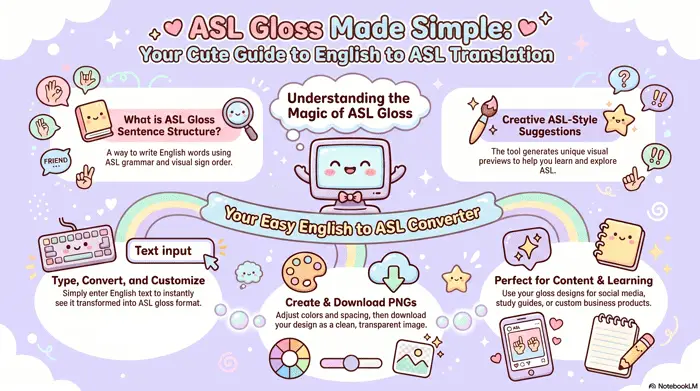
To streamline this transition, the ASL Gloss Translator serves as a powerful ASL font generator and conversion engine. It is designed to help deaf individuals and learners with free typing and font translation, effectively acting as an easy english to asl converter. By entering names, words, or full sentences, the tool generates an asl gloss translator suggestion that transforms standard text into a visual, ASL-style text design.
When using this text to asl translator, you are engaging with a creative preview of how English messages might be structured visually. This serves as a practical english to asl grammar translator for those looking to model conceptual ideas quickly.
Note: ASL grammar is highly dynamic and can vary significantly based on context, the individual signer, and regional dialects. These generated suggestions should be viewed as an educational and creative starting point rather than an absolute grammatical authority.
Use Free ASL Gloss Translator online
Design Beyond the Sign: Customizing Your Visual Language
As an instructional designer, I recognize that visual accessibility is just as important as linguistic accuracy. This tool offers several technical features that allow users to fine-tune their designs for maximum impact:
- Typography Controls: You can adjust the size, line spacing, and letter spacing to ensure the “asl font” is legible and aesthetically balanced.
- Styling & Themes: The tool allows for custom colors and aspect ratios, offering both a “normal design” and a dedicated dark version to suit various viewing environments.
- High-Quality Exports: Once a design is perfected, it can be exported as a clean PNG.
The Transparent PNG option is a significant asset for creators. By removing the background, these graphics can be integrated into complex digital mockups, making them a versatile tool for anyone looking to normalize the presence of sign language in digital and physical spaces.
From Classroom to Commerce: Surprising Ways to Use ASL Graphics
The transition from a computer screen to real-world application is where these visual translations truly shine. The ability to generate high-quality, transparent graphics opens doors for personal, educational, and professional projects.
Personal & Social Users can create unique “sign language text message” style graphics to share on social platforms. It is also an ideal way to generate custom name art for profiles or personalized digital greetings.
Educational In learning environments, these designs serve as vital learning visuals. They are excellent for ASL typing practice, creating visual prompts for students, or designing classroom aids that help beginners internalize sign shapes and structures.
Entrepreneurial For small business owners and digital creators, the tool provides a foundation for several commercial ventures:
- Apparel & Merch: Designing T-shirts, mugs, and stickers.
- Stationery: Creating notebook covers and printable quotes.
- Professional Services: Offering social media content services, page branding ideas, and creating custom gift messages or digital product mockups for clients.
ASL Picture Dictionary Online – Sign Words with Pictures: https://asltyping.com/asl-picture-dictionary-online/
A Gentle Entry Point for Beginners and Lifelong Learners
For those just beginning to explore “what is asl in sign language,” the entry point should be welcoming, not overwhelming. This tool lowers the barrier to entry by providing a low-pressure environment for asl typing words and testing short practice phrases. Features like the “Show Alphabet” option allow users to immediately connect written letters with their manual counterparts.
Beyond simple mechanics, this tool fosters a deeper curiosity about the diversity within the signing community. For instance, it can spark interest in the linguistic nuances and cultural history that define the difference between ASL and Black ASL (BASL). By providing “help in asl” through visual feedback, it encourages a lifelong journey of learning and cultural appreciation.
The Future of Visual Expression
Visual translation tools are more than just a convenience; they are a creative support system for the ASL community and its allies. By converting linear English into a spatial format, we can better appreciate the structural beauty of sign language. As we continue to develop these technologies, we must ask ourselves: how can the normalization of ASL fonts and visual graphics on everyday items—from T-shirts to public signage—help bridge the gap between spoken and signed languages in our shared public spaces?